
Feb 25 2025
Design Discovery & Relationships
Children are constantly in awe of learning new things. Through a child’s natural curiosity they learn about the world, creating stimulation for their brain and encouraging creativity and innovation. As we grow older, we become more familiar with the world around us. Our interests become more complex and nuanced. To find new discoveries, we elevate the depths of our exploration moving from familiarization to dissection.
Humans have a compulsory need to discover. Being formed by an eternal G-d, man was designed with the need for the eternal. This inherent need brings opportunity for the designer whose nature is discovery. The core strength of a good design is in taking the familiar and reintroducing it in a new way. Design acts as an exploration of material, an examination of concepts and formulates a new collective. Adults delight in the arrangement, collection, and recontextualization of the familiar to renew the spark of childhood intrigue. Whether it be in how we engage with our favorite medium, the arrangement and collection of household oddities, or our engagements with daily relationship, we seek the new within the familiar. Design facilitates that notion. Whether taken as an art form or the functional basis of a user experience, design starts with elements of information and radically transforms it into a new intelligence.
Discover Leads To:
In this way, design is just as interested in the collective as it is in the individual components. The respect of one element becomes either more prominent or transparent by the grouping of its counterparts. In much the same way that signage for a business is read different in a rural or urban environment, or how in the same way a three-story building is either display prominently in a small town or cowers in a metropolitan area; meaning is derived by the relationships of each corresponding element.
Discovery Through Play
I would hence postulate that good design is the discovery of an interconnection of relationships that derives new meaning. It is the perpetual dive into the eternal to find all the deepest depths of that which is but is yet understood. Once again learning from children, we understand that children do not undercover the world around them through meticulous study and dogmatism; they play. My two-year-old son may first put on a pair of sunglasses on his head twenty times in strange, bizarre manners before he concludes that they are best seated on the ears and nose. Even then after, finding the appropriate means of wearing them, he may conclude that there are additional “functions” that he has yet to uncover and proceeds then to interact with them in a variety of bizarre ways. Even when the design of the shades themselves supposedly yells at him to wear in such a specified manner, it is not immediately apparent that the article which he has never discovered is for what purpose it is created to be.
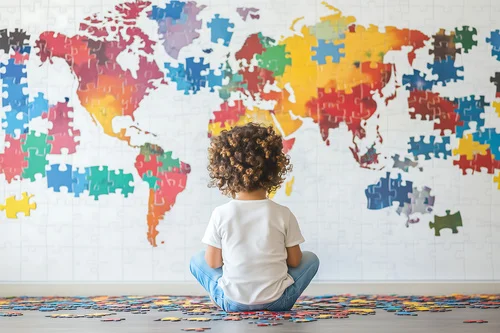
Similarly, the designer will never be able to discover deeper depths without opportunities of play. How does one define for what purpose purple exists for? At what point have we derived the purpose of that color or how it is defined? With typography, we understand the history of many typefaces, but does that tell us the entire breadth of their usefulness? As we continue to consider additional elements, new opportunities emerge, and new questions demand the attention of the designer.
In the professional world we may use the word research to describe play. However, the way the designer arranges colors, type, visuals and thought is no different from how a child might arrange blocks or colors on a paper. The only key difference may be in the establishment of a desired outcome. Regardless, whether you call it research or play, or whether there is an end goal or not, by the mere act of performing the task, new relationships are discovered, new ideas are formulated and creativity manifests. Without the appropriate amount of play, design becomes redundant; that sense of discovery that drives man to excitement and engagement is lost. Play is a form of exploration that leads to discovery.
Design Explores:
Internal Relationships
On the topic of color, Joseph Alber writes “it should be learned that one and the same color evokes innumerable readings. Instead of mechanically applying or merely implying laws and rules of color harmony, distinct color effects are produced -through recognition of the interaction of color-” Likewise Ellen Lupton describes the relationship of typefaces as a salad where each typeface is a “different color, taste. and texture.” Furthering the food analogy, when we see each design element as its own flavor, texture, and color - wherein specific design element categories may fill the roles of fat, spice, sweetness, etc. - the final product becomes either the hors d’oeuvre or plat principal (which can be perceived as elements amounting to an even greater collective).
Architects design spaces that facilitate progression, autonomy, and intrigue. Level designer design digital spaces that facilitate a similar experience. For the level designer specifically, they aim to create a small world with its own defined rules; the level geometry creates an environment that exudes an open air of freedom for the user despite the fact that they are being guided by the designer to stay on an appropriate path. In the same way, the greatest architect designed this world as a spherical globe with a set of parameters that enables freedom, while keeping us confined to the earth (our designated play area).
Both disciplines, architecture and level design in gaming articulate an experience through the expression of design. Other design fields could learn well from level designers and architects. For the graphic designer, the page becomes the space, and the design elements becomes the architecture. On the page, the graphic designer designated the landmarks, the corridors, the rest areas, and the spaces in between that allow your abstracted “architecture” flourish. Each element is part of a greater collective whole. This collective whole then has opportunity to be a new taste of discovery.
Examples of Design Relationships
Holism in Design
On the topic of Holism, we can learn about design from creation around us. Designers design for humans, all of which share an experience of living on this planet. We can see the world as having its own design language. If design is a series of relationships, then approaching some apparent collective whole becomes the natural conclusion of continued discovery. Depending on how we perceive the collective whole, the collection takes shape; in the prospect of seeing eternity as the divine conclusion, every effort is thereby a deepening elevation of enlightenment of the growing universe; discovery itself becomes worship to the eternal conclusion.
In essence design is spiritual, if we see the world as a constructed world made by a loving creator, those concepts can be captured into the design work. Conversely, if we view the world as chaotic and random - an outcome of natural selection - that will echo into our design work just as well. The nature of these relationships reverberates on both a cosmic and intimate scale; personal reflection in every chamber of our mind abstracting into relationships between color, type, and everything in-between.
Thusly design is just as carnal as it is spiritual, the design capabilities defined by a limited perspective of reality; a perversion of truth, both the designers view of existence and the viewers distortion of that viewpoint. This connects back to a fundamental understanding of how external relationships define a visual piece and connect invisible relationships that are not intrinsic to the design itself.
Italo Calvino writes “I would say the moment an object appears in a narrative it becomes like the pole of a magnetic field, a knot in the network of invisible relationships.” What Calvino argues is that the narrative of an object is not only in its apparent relationship on the medium, but symbolism that is inherent to the object itself, a network of relationships that is carried by the viewer, hence adding to the work with what is not immediately apparent.
The relationship of an object (and on a greater scope, the cohesive whole of the product) becomes interpersonal to the viewer. It becomes the designer’s job then to see the elements in their isolated states, understand the stories they tell and combine them in such a way to say something interesting to the viewer, to create a new way to discover the familiar.
Inevitably we see the design space become a battlefield of the carnal and spiritual, between flesh and spirit or Id and Superego. At once, such warfare occurs for both designer and audience. For the designer, the battle is by nature about desire and burden. For the audience, it is a matter of internal/external interpretation.
Knowing this, the designer has as much of a moral responsibility for how they convey their message as they have an administrative responsibility. While it is impossible for any work to be statically transferred from the designer’s mind to his/her audience, the means of communication in the designer toolbelt may mitigate miscommunication. Hence, the designer has the opportunity to uncover new realms of discovery, to which it in itself may prove to be either beneficial or detrimental to his/her circle or influence. Still, a third outcome is plausible, the designer could bore the crap out of his/her audience, producing content of no functional, societal or pleasurable use.
This leads back to the importance of discovery in design. Discovery allows us to uncover what may have at once been hidden. The designer finds the excitement, the burdens and the opportunities. In the realm of spiritualism, it is like finding a smell that wasn’t apparent before. Similar to how certain smells could bring us back to childhood, the designer is able to uncover feelings that connect us in a metaphysical way.
Albers, Josef. (2013) Interaction of Color: 50th Anniversary Edition, Yale University Press
Calvino Italo. (1988) Six Memos for the New Millennium, Cambridge, Mass. : Harvard University Press.
Lupton, Ellen. (2010) Thinking with Type 2nd revised ed, Princeton Architectural Press